







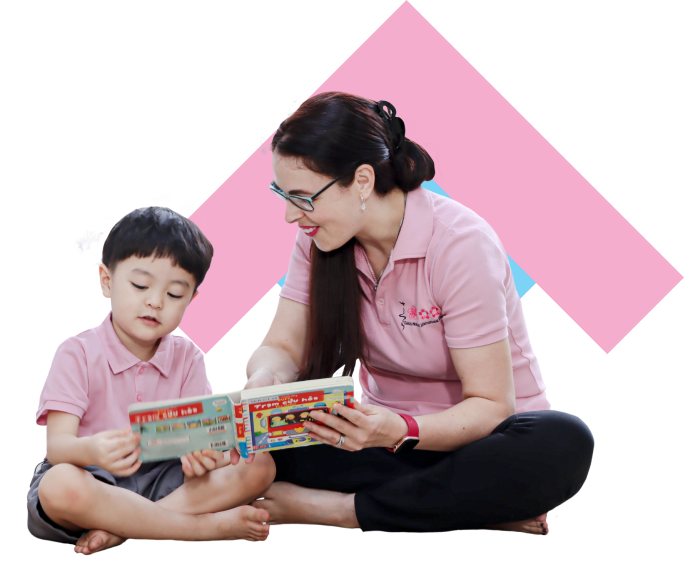
The English Language Art program is designed by Mount Vernon School based on the Common Core State Standards for Early Childhood Education with outstanding benefits: A reliable partner

Mount Vernon School (MVS) is one of the 10 most innovative schools in the US, with about 1,100 students from nursery to high school nationwide. With experienced educators, MVS provides the services of curriculum designing and training consultancy for nearly 200 schools and training institutions in different countries in the world. The mutual perspective of a “person-centered approach to boost the development of human beings” is the foundation for the strategic partnership between Sakura Montessori and Mount Vernon in designing and developing the English program based on the Common Core State Standards for early childhood education.
The English program is designed based on some critical criteria of Common Core – the fundamental standard for education in the US – for language development appropriate for Vietnamese children in general and Sakura Montessori’s students in particular, taking into consideration psychological features as well as the linguistic acquisition ability of children.
Children can achieve desired phonics, vocabulary, grammar, and skills of listening-speaking-reading-writing in English, making a foundation for their higher education later in life.
Incremental learning pathway and learning outcomes
- Level 1 – Seeding (for children between 0-3): Focus on monophthongs, simple theme-based vocabulary, helping children understand simple orders and answer simple questions, etc.
- Level 2 – Sprouting (for children between 3-4.5): Focus on monophthongs, words containing those sounds, theme-based vocabulary, and simple structures along with speaking skills.
- Level 3 – Budding (for children between 4.5-6) (lower): Focus on monophthongs and the combination of sounds, allowing children to understand and distinguish theme-based words, and structures, develop speaking skills and start reading single words and writing (word tracing).
- Level 4 – Blossoming (for children between 4.5-6) (upper): Focus on monophthongs, diphthongs, words containing sounds, with a reinforcement of theme-based vocabulary, structure, and skills of listening-speaking-reading-writing (words & sentences).
A wide range of themes/topics familiar with children
Including colors, numbers, shapes, the school, body parts, family, pets, etc. with related structures.
Interesting learning projects
Children acquire knowledge through learning activities and projects including songs, handiwork, finger puppets, role play, storytelling, Show and Tell for Sprouting (3-4.5), Mock Interviews for Budding and Blossoming (4.5-6), etc.
ELA (English Language Art) lessons at Sakura Montessori are always cheerful with children speaking English in interactive activities such as Storytelling, Show & Tell, and Mock interviews. These are the 3 favorite activities of children at Sakura Montessori amongst various activities throughout the week.
In this way, young children get to know a wide range of interactions and improve their ability to respond in English in the most natural way. Let’s see how interesting those lessons are!
Creative teaching methods to encourage a passion for and the use of English in children
Creative teaching methods to encourage a passion for and the use of English in children
- TPR (Total Physical Response): Teachers combine language with physical movement. Children are encouraged to use their body movements to respond and interact immediately with teachers, forming a natural response in listening and speaking.
- SSS (Short Simple Story): The use of short English stories from different topics to help children practice their reading skills and develop their phonics, structures, and vocabulary.
- PPP (Presentation, Practice, Production): The teaching and learning of English are carried out in 3 steps: Presentation (instructions in combination with games, music, photos, real objects, etc.) – Practice (children practice) – Production (children create their own products from the lesson and practice). Children are active in approaching the language and using it in real-life situations.
- Scaffolding: Teachers support children in their acquisition of knowledge and skills with difficulty gradually increased; at the same time instruct, observe, and evaluate their progress over time.
The assessment system for the linguistic development of children
At Sakura Montessori, teachers observe the progress of children over each lesson and report their progress every 2 units, at the same time doing an assessment of what children have learned in the format of a Mock Interview (in-person talk) at the end of each semester.
A new assessment system is used at Sakura Montessori, including the following levels: Novice, Emerging, and Proficient to evaluate the linguistic development of children in the most accurate, objective, and comprehensive way. In that way, teachers can decide on the additional support for each child.
The assessment and detailed feedback will be sent to parents during the Parent Meeting at the end of each semester.
Academic staff
100% English native teachers at Sakura Montessori possess international teaching certificates (TESOL/CELTA/TEFL) and rich experience in working with young children. To improve teaching quality, professional training courses are regularly organized on a monthly/yearly basis for teachers to improve their knowledge and skills.

- Giáo viên Montessori Quốc tế được chứng nhận bởi Hiệp hội Phát triển Montessori Quốc tế (IAPM).
- Tốt nghiệp Đại học Sư phạm Hà Nội
- 13 năm kinh nghiệm làm việc với trẻ nhỏ
Vừa tốt nghiệp đại học, cô Lã Thị Phương Thảo đã bén duyên với Sakura Montessori và gắn bó đến nay đã được 13 năm. Trong một thập kỷ làm việc với các bạn nhỏ tại Sakura Montessori, cô Phương Thảo luôn theo đuổi phương châm giáo dục cá nhân hóa dựa vào thiên hướng phát triển, cá tính riêng của mỗi cá nhân trẻ cũng như phù hợp với từng giai đoạn phát triển của trẻ để đạt được hiệu quả cao nhất.


